Category: Uncategorized

  • Why Your Invoices Go Out Late — And the 3 Systems That Fix It Forever

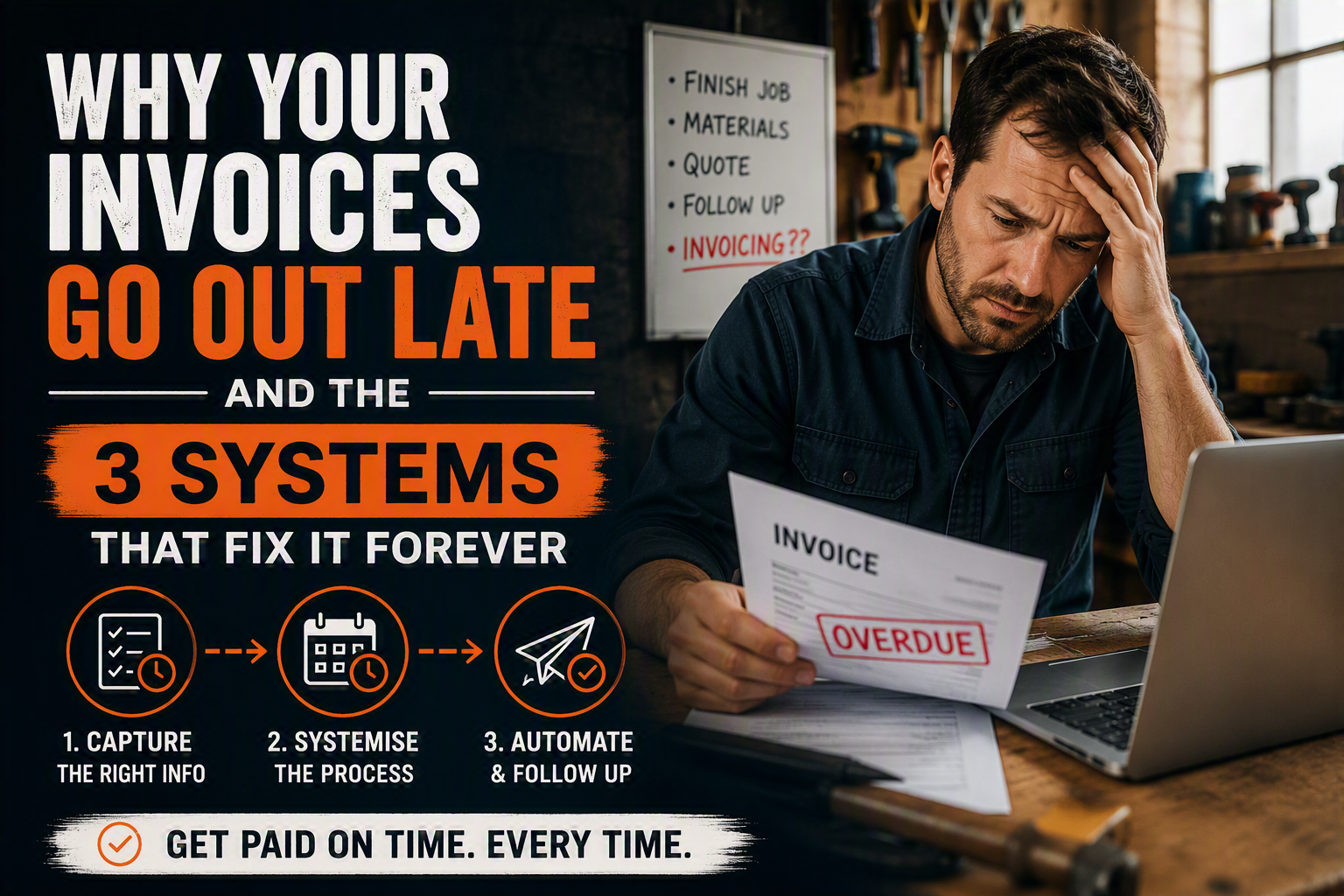
    Why Your Invoices Go Out Late — And the 3 Systems That Fix It Forever

    Why Your Invoices Go Out Late
    — And the 3 Systems That Fix It Forever

    Most tradies don’t have an invoicing problem. They have a system problem. Here’s how to build one that runs itself — and gets you paid on time, every time.

    47%
    of trade invoices are sent more than 7 days after job completion — and every day of delay stretches your cash cycle.

    Monday morning. You finish a job that took three days. The customer is happy. You pack up, head to the next site, and tell yourself you’ll invoice tonight.

    Friday rolls around. The invoice still hasn’t gone out. Now it’s the weekend. Monday the customer gets it — nine days after the work was done. By the time they pay, you’re looking at a four-week gap between doing the work and seeing the cash.

    This isn’t laziness. It’s a broken system. And it’s costing you more than you think.

    “Every week you delay invoicing is a week you’re funding your client’s cash flow — for free.”

    The Real Reason Invoices Are Late

    In our experience working with trade businesses across New Zealand, late invoicing almost never comes down to a lazy owner or forgetful admin. It’s a workflow problem disguised as a people problem.

    There are three root causes we see again and again:

    The invoicing flow — where tradies get stuck
    Job done
    Work completed on site
    × No trigger
    No system auto-creates invoice
    × Data scattered
    Materials, hours, variations to find
    × No owner
    “I’ll do it later” — nobody does
    Invoice sent
    7+ days later (or never)

    The gap between “job done” and “invoice sent” is where cash disappears. Every day that gap widens, your business is quietly funding the work you’ve already done — without being paid for it.

    What delayed invoicing costs you
    $5,000 average job
    1 day delay
    5 jobs per week
    $25,000 tied up
    7-day invoicing gap
    $175,000 in WIP
    That’s $175,000 of work you’ve already done but haven’t been paid for. With a proper system, you could reduce that gap to 24 hours — freeing up cash without doing an extra hour of work.

    The 3 Systems That Fix It Forever

    Every tradie business that gets invoicing right uses the same three systems. Not complicated software. Not expensive tools. Just clear, repeatable workflows that remove the friction between job completion and getting paid.

    Here’s what they look like in practice:

    01
    Completion Trigger
    When a job status changes to “complete,” a draft invoice is created automatically. No remembering. No “I’ll do it later.” The system fires, and the invoice exists.
    02
    Pre-Approved Rates & Variations
    Every job has a clear price before work starts. Variations get approved in writing before they’re done. No “what do I charge for this?” delays at invoice time.
    03
    Weekly Invoice Run
    Same time every week. One person reviews, one person sends. No exceptions. A fixed cadence creates accountability — and a predictable cash flow rhythm.

    Before vs. After: The System Difference

    Here’s what the same workflow looks like with and without these three systems in place:

    Without the system
    • Invoices sent 7–14 days after job completion
    • Variations chased up after the fact
    • No idea which jobs are unbilled
    • Cash flow feels random and reactive
    • Owner chases payments manually
    With the system
    • Invoices sent within 24 hours every time
    • Variations pre-approved, no delays
    • Real-time view of all unbilled work
    • Cash flow is predictable and controlled
    • Collection sequence runs on autopilot

    Your Invoicing System Checklist

    Use this to score your current setup:

    Trigger set — job completion auto-generates a draft invoice
    Rates locked — every job has a pre-agreed price or rate card
    Cadence fixed — same day every week for review and sending
    Owner assigned — one person owns the weekly run, no ambiguity
    Collection sequence — automated reminders, escalation, follow-up

    How TradieHQ Fits In

    At TradieHQ, we don’t just “process your invoices.” We build the entire system around your business — from the software triggers to the weekly run to the collection sequence that follows up automatically.

    We connect your job management tool (Fergus, Xero, SimPRO, or even a whiteboard) to a predictable invoicing workflow. Your team does the work. We make sure the invoice goes out — on time, every time.

    The result? Faster payment, clearer cash flow visibility, and a business that runs on systems instead of owner attention.

    And because our model is variable cost, you pay based on your invoice volume — not a full-time hire sitting idle half the month.

    Free Invoicing & Collection Audit

    We’ll review your current invoicing flow, identify the leaks, and show you exactly how much faster you could be getting paid. No obligation.

    Claim your free audit →

  • The 7 Numbers Every NZ Tradie Should Check Every Month

    The 7 Numbers Every NZ Tradie Should Check Every Month

    The 7 Numbers Every NZ
    Tradie Should Check
    Every Month

    Your business can feel busy and still be leaking profit. These seven monthly numbers give you a clear pulse on cash, margin and whether the business is moving in the right direction.

    7
    monthly numbers that tell you whether the business is healthy, profitable and cash-positive.

    Most tradies can tell you how busy they are. The better question is whether that busyness is actually turning into profit.

    These seven numbers are the ones every New Zealand trade business should check once a month. They are not glamorous, but they are the best early warning system for cash flow trouble, shrinking margins and work that is costing more than it earns.

    Revenue

    Revenue shows how much work your business has converted into invoices. It is the base of everything, but it is only useful when paired with the next numbers.

    If revenue is rising but profits are flat or falling, the business is probably growing in volume without growing in value.

    Gross margin

    Gross margin measures the money left after you pay direct costs such as materials, subcontractors and labour for the job. It is the clearest signal of whether your pricing and job costing are strong.

    A tradie business can have decent revenue and still be weak if gross margin is too low. Tracking this every month means you can see the impact of material cost changes, subcontractor spend and pricing decisions quickly.

    Labour recovery

    Labour recovery shows whether the hours your team works are being recovered in invoices. This is often the number that separates busy but unprofitable businesses from ones that actually generate cash.

    If your crew is spending time on work that is not fully billed, or if you're writing off hours regularly, the business is quietly losing money.

    Work in progress

    Work in progress (WIP) is the value of jobs that are started but not yet complete or invoiced. It is a vital measure of jobs that are still tied up in the business.

    Too much WIP can mean you are carrying risk and cash tied up in unfinished work. Too little can mean you are not tracking jobs properly or that completed work is not being moved to invoicing fast enough.

    Debtors

    Debtors are the amounts customers owe you. This number is one of the biggest cash flow pressure points for tradie businesses.

    High debtor balances usually mean invoices are not being chased, terms are too soft, or collection processes are weak. It is the difference between getting paid on time and funding other people’s credit.

    Cash in bank

    Cash in the bank is the number that matters most when it comes to survival and growth. Revenue, margin and debtors are important, but actual cash tells you whether you can pay wages, suppliers and tax.

    When cash is low, the business is vulnerable even if the numbers on paper look okay. Healthy cash levels reduce stress and give you room to make better decisions.

    Net profit

    Net profit is the bottom line after all expenses have been accounted for. It shows whether the business is generating enough surplus to fund future investment, tax and owner drawings.

    Tracking net profit monthly keeps the focus on real results, not just sales or activity.

    "If you review the right seven numbers every month, you can spot the problem before it turns into a cash crisis."

    These seven numbers are the backbone of a simple, effective monthly review. They keep the focus on cash, margin and the true profitability of the work you deliver.

    Want a monthly dashboard that actually helps?

    We help trade businesses turn these numbers into a reporting rhythm that drives better decisions and better cash flow.

    Book a business review →